Hotel wardrobes are often one of the most overlooked elements in guestroom design. Many hotel projects focus heavily on beds, seating, and decorative finishes, while wardrobe planning is left until the later stages of design development. However, after years of operation, it is often the wardrobe that generates some of the most common guest complaints and maintenance issues.
Insufficient hanging space, poorly designed luggage storage, inconvenient safe locations, inadequate lighting, and limited organization options can negatively affect the guest experience. At the same time, inefficient wardrobe layouts can create extra work for housekeeping teams, reduce room functionality, and increase long-term maintenance costs.
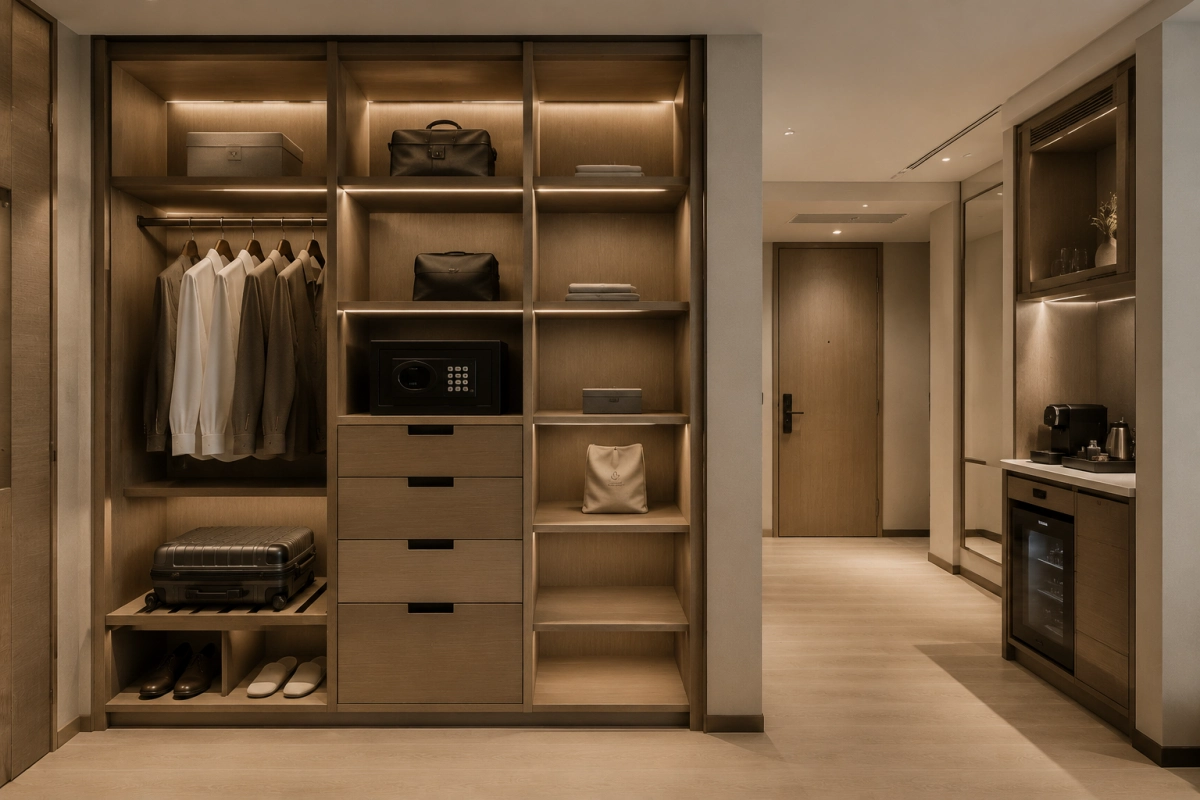
After nearly two decades of working with hospitality projects, we’ve found that a well-designed hotel wardrobe is much more than a storage cabinet. It serves multiple functions within a guestroom, including storing clothing, accommodating luggage, integrating in-room safes, organizing slippers and laundry bags, and supporting the needs of both short-term and extended-stay guests. The wardrobe also contributes to the overall visual identity of the room and plays an important role in maximizing available space.
From an operational perspective, thoughtful hotel wardrobe design can improve housekeeping efficiency, enhance guest satisfaction, reinforce brand standards, and reduce future repair and replacement costs. Whether for a luxury resort, boutique hotel, business property, or extended-stay accommodation, the right wardrobe solution should balance functionality, durability, and aesthetics.
Drawing on 18 years of experience in custom hospitality furniture manufacturing, this guide explores everything hotel owners, designers, and procurement teams should know about selecting and designing modern hotel wardrobes. From layout planning and standard dimensions to materials, storage solutions, and custom features, we’ll share practical insights to help create guestroom furniture that performs as well as it looks.
Types of Hotel Wardrobes and Essential Features
There is no one-size-fits-all solution when it comes to hotel wardrobes. The ideal design depends on the hotel’s positioning, room size, guest profile, and operational requirements. Luxury resorts, boutique hotels, business properties, and extended-stay accommodations often require different wardrobe configurations to balance guest convenience with available space.
Over the years, hospitality projects have gradually evolved from simple hanging closets to highly functional storage systems that integrate luggage space, in-room safes, lighting, and other guest amenities. Choosing the right wardrobe type can significantly improve both guest satisfaction and room efficiency.
Common Types of Hotel Wardrobes
| Wardrobe Type | Pros | Cons | Best Applications |
|---|---|---|---|
| Built-in Wardrobe | Maximizes space, seamless appearance, highly customizable | Fixed installation | Most hotel guestrooms |
| Freestanding Wardrobe | Flexible and easy to replace | Takes up more floor space | Boutique hotels and renovations |
| Walk-in Wardrobe | Premium guest experience and large storage capacity | Requires significant room area | Luxury suites and presidential suites |
| Open Closet | Modern appearance and easy guest access | Limited concealed storage | Lifestyle and business hotels |
| Suite Wardrobe | Combines hanging, shelving, and luggage storage | Higher manufacturing cost | Executive and family suites |
| Luxury Dressing Area | Creates an upscale residential feel | Large footprint and custom construction | Luxury hotels and high-end resorts |
Swipe horizontally to view the full table.
While the wardrobe structure is important, the internal organization often has a greater impact on guest satisfaction. Modern hotel wardrobe design should accommodate both short-term and extended-stay travelers while making housekeeping operations more efficient.
Essential Features Every Hotel Wardrobe Should Include
A well-designed hotel wardrobe should provide dedicated storage for the items guests use most frequently. Depending on the hotel category and room size, common features include:
| Feature | Purpose |
|---|---|
| Hanging Rail | Store coats, dresses, and business attire |
| Luggage Shelf | Keep suitcases off the floor for convenience |
| Drawers | Organize smaller personal belongings |
| In-room Safe | Secure storage for valuables |
| Mini Bar Compartment | Integrate refreshments and amenities |
| Laundry Bag Storage | Improve guest convenience |
| Iron & Ironing Board Space | Support business and long-stay guests |
| Integrated Lighting | Improve visibility and enhance luxury |
| Full-Length Mirror | Assist daily dressing routines |
| USB & Power Outlets | Charge devices inside or near the wardrobe |
| Hooks | Hang bags, jackets, or umbrellas |
| Shoe Rack | Organize footwear neatly |
| Open Storage Shelves | Display or store frequently used items |
Swipe horizontally to view the full table.
Rather than trying to include every possible feature, hotels should prioritize storage solutions that match their target guests and operational needs. For example, business hotels may emphasize hanging space and ironing facilities, while luxury resorts often integrate dressing areas, enhanced lighting, and premium storage options. The best hotel wardrobes combine thoughtful organization with durable construction and attractive aesthetics, creating furniture that enhances the guest experience while supporting efficient hotel operations.

Recommended Hotel Wardrobe Dimensions and Space Planning
One of the most common questions from hotel owners and designers is: “What is the standard size of a hotel wardrobe?” The answer depends on the hotel’s positioning, guestroom layout, and target market. Business hotels, resorts, extended-stay properties, and luxury suites all have different storage requirements.
Rather than following a single standard, successful hospitality projects focus on providing enough storage for guest comfort while maximizing available floor space. A well-planned wardrobe should accommodate clothing, luggage, valuables, and daily essentials without making the room feel crowded.
Recommended Hotel Wardrobe Dimensions
| Component | Recommended Size |
|---|---|
| Overall Depth | 600–650 mm (24–26 in) |
| Overall Width | 1000–1800 mm (39–71 in) |
| Overall Height | 2200–2400 mm (87–94 in) |
| Hanging Space Height | 1000–1700 mm (39–67 in) |
| Drawer Depth | 450–550 mm (18–22 in) |
| Luggage Shelf Height | 500–600 mm (20–24 in) |
| Safe Compartment | Approximately 450 × 450 × 250 mm |
| Shoe Storage Height | 150–200 mm per shelf |
| Upper Storage Shelf | 300–400 mm high |
Swipe horizontally to view the full table.
These dimensions serve as practical guidelines and can be adjusted based on the room layout and hotel category.
Space Planning Considerations
A successful hotel wardrobe design is not simply about maximizing storage. It should support the daily routines of guests while remaining easy for housekeeping staff to maintain.
Key considerations include:
- Providing sufficient hanging space for business and leisure travelers.
- Incorporating dedicated luggage storage to keep suitcases off the floor.
- Positioning the in-room safe at a convenient, ergonomic height.
- Including drawers and open shelving for smaller personal items.
- Allowing enough clearance for wardrobe doors to open comfortably.
- Integrating lighting to improve visibility inside the wardrobe.
For luxury hotels and extended-stay properties, larger wardrobes may include separate sections for long garments, additional shelving, dressing areas, or integrated mini bars.
Hotel Category Recommendations
| Hotel Type | Suggested Wardrobe Width |
|---|---|
| Economy Hotel | 1000–1200 mm |
| Mid-Scale Hotel | 1200–1400 mm |
| Upscale Hotel | 1400–1600 mm |
| Luxury Hotel | 1600–1800 mm or larger |
| Suites & Extended Stay | Custom dimensions based on layout |
Swipe horizontally to view the full table.
Ultimately, the best wardrobe dimensions balance guest expectations with available space and operational efficiency. Oversized wardrobes can reduce usable floor area, while undersized units may negatively impact the guest experience. Early coordination between architects, interior designers, and furniture manufacturers helps ensure that wardrobe layouts are both practical and visually integrated into the overall guestroom design.

Materials for Hotel Wardrobes
Selecting the right materials for hotel wardrobes is critical to ensure durability, aesthetic consistency, and ease of maintenance. High-quality materials not only improve the guest experience but also reduce long-term operational costs.
| Material | Advantages | Considerations / Best Use |
|---|---|---|
| Plywood | Strong, moisture-resistant, stable | Ideal for cabinet carcasses and shelving in humid areas |
| MDF (Medium-Density Fiberboard) | Smooth finish, easy to paint, stable | Perfect for door panels and decorative surfaces |
| Particle Board | Economical, lightweight | Suitable for non-load-bearing components, avoid high-humidity zones |
| Veneer | Natural wood appearance, premium look | Can be applied over MDF or plywood for upscale aesthetics |
| Laminate | Durable, scratch and stain-resistant | Great for mid-range hotels, easy maintenance |
| Melamine | Cost-effective, moisture-resistant | Suitable for budget or back-of-house wardrobes |
| PU / Painted Finishes | Smooth, modern look, variety of colors | Use for contemporary styles; avoid scratches |
| Hardware (Blum, Hettich) | High-quality hinges, slides, soft-close mechanisms | Essential for daily heavy use and long-lasting performance |
Swipe horizontally to view the full table.
Key Points for Hotel Wardrobes
- Durability: Choose materials that withstand frequent use by guests and housekeeping staff.
- Maintenance: Surfaces should be easy to clean and resistant to moisture, spills, and scratches.
- Consistency: Material selection should align with room design and overall hotel brand aesthetics.
- Hardware Integration: Premium brands like Blum and Hettich offer soft-close drawers and hinges that enhance longevity and guest experience.
- Sustainability: Opt for certified materials (FSC, CARB, E0/E1) to align with green hotel initiatives.
By carefully combining structural materials (plywood, MDF) with high-quality finishes (veneer, laminate, PU) and reliable hardware, hotel wardrobes can remain functional, visually appealing, and long-lasting throughout the lifecycle of the property.

Built-in vs Freestanding Hotel Wardrobes: Which Is Better?
One of the most common decisions during guestroom planning is whether to specify a built-in hotel wardrobe or a freestanding unit. Both options offer unique advantages, and the right choice depends on the hotel’s concept, room layout, budget, and long-term operational strategy.
In modern hospitality projects, built-in wardrobes have become increasingly popular because they maximize available space and create a seamless, integrated appearance. As part of the overall hotel fixed furniture package, they can be customized to fit the exact dimensions of the guestroom while coordinating with other casegoods such as TV units, mini bars, and vanities.
Freestanding wardrobes, on the other hand, provide greater flexibility and can be replaced or relocated more easily during future renovations. They are often used in boutique hotels, adaptive reuse projects, or properties where structural modifications are limited.
Built-in vs Freestanding Hotel Wardrobes
| Feature | Built-in Wardrobe | Freestanding Wardrobe |
|---|---|---|
| Space Efficiency | Excellent | Good |
| Customization | Highly customizable | Limited |
| Integration with Room Design | Seamless | Independent furniture piece |
| Installation | Permanent | Easy to install and replace |
| Maintenance | More complex | Simpler replacement |
| Renovation Flexibility | Lower | Higher |
| Storage Capacity | Higher | Moderate |
| Initial Investment | Higher | Lower |
| Best For | New-build hotels and major renovations | Boutique hotels and refurbishment projects |
Swipe horizontally to view the full table.
Why Built-in Wardrobes Are Preferred in Hotels
For most hospitality projects, built-in wardrobes offer several operational advantages:
- Maximize available guestroom space.
- Create a clean and consistent interior design.
- Integrate luggage shelves, safes, mini bars, and lighting into a single unit.
- Reduce gaps where dust and debris can accumulate, simplifying housekeeping.
- Coordinate seamlessly with other fixed furniture and millwork.
Because they are custom manufactured, built-in wardrobes can also adapt to challenging room layouts and brand-specific design requirements.
When Freestanding Wardrobes Make Sense
Freestanding wardrobes can be an effective solution for certain hospitality concepts, particularly when flexibility is a priority. They are commonly specified for:
- Boutique hotels with unique room layouts.
- Historic building conversions.
- Refurbishment projects with limited structural modifications.
- Properties that anticipate future room reconfigurations.
Since they are not permanently fixed to the building, freestanding units can be replaced individually without extensive renovation work.
Which Option Should You Choose?
There is no universal answer. For most new hotel construction and large-scale renovation projects, built-in wardrobes provide the best balance of functionality, aesthetics, and long-term operational value. Freestanding wardrobes, however, remain a practical choice for projects requiring greater flexibility or lower upfront investment. The decision should ultimately consider guest expectations, available space, housekeeping efficiency, maintenance requirements, and the overall hotel design concept.
Choosing a Hotel Wardrobe Manufacturer
Selecting the right manufacturer is critical to ensure your hotel wardrobes meet design, durability, and operational expectations. Focus on suppliers with proven customization capabilities, the ability to produce accurate shop drawings, and experience managing production, quality control (QC), and installation.
For seamless project execution, look for manufacturers who can coordinate with your FF&E plan, support built-in furniture integration, and provide guidance for both guestroom and public area wardrobes.
Conclusion
A hotel wardrobe is far more than a place for guests to store their belongings. When thoughtfully designed, it becomes an essential part of the guestroom experience, helping guests stay organized while supporting efficient housekeeping operations and reinforcing the hotel’s overall design concept.
As we’ve explored throughout this guide, choosing the right wardrobe involves much more than selecting a style. Factors such as layout, dimensions, storage features, materials, construction quality, and built-in versus freestanding configurations all influence guest satisfaction, operational efficiency, and long-term maintenance costs. A well-planned wardrobe can maximize available space, improve functionality, and provide lasting value throughout the hotel’s lifecycle.
For hotel owners, designers, and procurement teams, the goal should be to create wardrobe solutions that balance aesthetics, durability, and practicality while meeting the expectations of modern travelers. Whether for a business hotel, boutique property, luxury resort, or extended-stay accommodation, investing in well-designed hotel wardrobes can contribute to a better guest experience and stronger long-term operational performance.
With nearly two decades of experience in hospitality furniture manufacturing, companies such as CenSo Home support hotel projects with custom hotel wardrobes, built-in furniture, hotel casegoods, and integrated FF&E solutions tailored to different hotel concepts and project requirements. From design development and shop drawings to manufacturing and project coordination, working with experienced hospitality specialists can help ensure wardrobe solutions are both functional and built to last.
FAQ
What is the standard size of a hotel wardrobe?
There is no universal standard, but most hotel wardrobes are approximately 600–650 mm (24–26 inches) deep, 1000–1800 mm (39–71 inches) wide, and 2200–2400 mm (87–94 inches) high. The ideal dimensions depend on the hotel’s category, room layout, and target guests.
What should a hotel wardrobe include?
A well-designed hotel wardrobe should provide more than hanging space. Common features include:
- Hanging rail
- Luggage shelf
- Drawers
- In-room safe
- Shoe storage
- Laundry bag compartment
- Iron and ironing board storage
- Full-length mirror
- Integrated lighting
- USB or power outlets
- Open shelving
The exact configuration should reflect the hotel’s operational and guest requirements.
Are built-in hotel wardrobes better than freestanding wardrobes?
For most new hotel projects, built-in hotel wardrobes are the preferred option because they maximize space, integrate with other fixed furniture, and create a seamless appearance. Freestanding wardrobes offer greater flexibility and are often suitable for renovations or boutique properties.
What materials are best for hotel wardrobes?
Commercial hotel wardrobes are commonly manufactured using plywood, MDF, or particle board with finishes such as veneer, laminate, melamine, or PU paint. High-quality hardware from brands like Blum and Hettich helps improve durability and long-term performance.
How much hanging space should a hotel wardrobe provide?
A typical hotel wardrobe should accommodate both short and long garments. Most guestrooms provide a hanging height of 1000–1700 mm (39–67 inches), with additional shelving for folded clothing and accessories.
Should hotel wardrobes include an in-room safe?
Yes. Most modern hotels integrate a safe into the wardrobe or adjacent cabinetry. Positioning the safe at an ergonomic height improves guest convenience and reduces bending or lifting.
What is the difference between a hotel wardrobe and a hotel closet?
The terms are often used interchangeably. A hotel wardrobe generally refers to the furniture unit itself, while a hotel closet may describe the overall storage area, including built-in shelving, hanging space, and integrated storage solutions.
How can hotel wardrobe design improve the guest experience?
A thoughtfully designed wardrobe helps guests organize their belongings, access luggage easily, store valuables securely, and maintain a clutter-free room. Good storage design contributes to comfort and overall guest satisfaction.
Can hotel wardrobes be fully customized?
Yes. Custom hotel wardrobes can be tailored to specific room layouts, brand standards, and operational needs. Hotels can customize dimensions, materials, finishes, internal storage configurations, lighting, hardware, and integrated features such as mini bars or safes.
What should hotels consider when choosing a hotel wardrobe manufacturer?
Hotels should evaluate a manufacturer’s:
- Hospitality project experience
- Customization capabilities
- Shop drawing support
- Material and hardware quality
- Production capacity
- Quality control procedures
- Installation coordination
- Project management expertis
Choosing an experienced hospitality furniture manufacturer helps ensure that wardrobe solutions meet both design expectations and long-term operational requirements.