SUPPLIER EVALUATION · 2026 HOTEL PROJECTS
Custom Hospitality Furniture Manufacturer
As a professional manufacturers 17 years, we know that selecting a custom hospitality furniture manufacturer is one of the most critical decisions in any hotel project. Hotel furniture involves complex coordination between customized design, production capability, quality control, logistics, and on-site delivery—often under tight construction timelines and high investment pressure.
For hotel owners, developers, contractors, and trading companies, the challenge is not just finding a supplier, but choosing a manufacturing partner who can manage custom furniture across multiple categories, from fixed furniture to loose furniture, while ensuring quality and delivery on time. A single mistake in furniture planning or execution can lead to project delays, budget overruns, or long-term maintenance issues after opening.
As hotel projects become more sophisticated in 2026—covering guest rooms, suites, public areas, and mixed-use spaces,the standards for suppliers will become increasingly higher. Manufacturers are no longer expected to only produce furniture, but to support hotel projects with integrated customization, production, and turnkey delivery capability.
This guide is designed to help hotel stakeholders understand what truly matters when choosing a custom hospitality furniture manufacturer, and how to evaluate suppliers beyond price and product appearance—so risks can be reduced and project outcomes improved.
Customization & Multi-Category Capability
In hotel projects, customization & multi-category capability means a manufacturer can customize furniture for different hotel areas and produce multiple furniture categories based on project-specific requirements, rather than offering standard sizes or isolated products.
This capability is especially important for hotels that require personalized design, varied room layouts, and consistent furniture across different spaces.
It typically includes:
- Fixed furniture: headboards, wardrobes, vanities, minibar units, wall panels
- Loose furniture: beds, sofas, chairs, tables for guest rooms, suites, and public areas
- Customized sizes, materials, finishes, and details based on drawings and room dimensions
In practice, fixed furniture is almost always customized, while loose furniture must be confirmed with the manufacturer to ensure it can also be produced according to project-specific sizes and specifications.
How to Identify Whether a Manufacturer Has This Capability
Rather than relying on product photos, hotel owners and developers can assess customization capability through a few practical checks:
Factory inspection or video call
Visiting the factory workshop or arranging a live video call helps verify whether cabinet production, finishing processes, and assembly are truly customized.
Ability to handle both fixed and loose furniture
A qualified manufacturer should clearly explain how different furniture categories are coordinated within one project, not treated as separate orders.
Technical drawings and project-based customization
Look for manufacturers that provide shop drawings and detailed specifications based on your room layouts, rather than standard catalog dimensions.
Consistency control across categories
Ask how materials, finishes, colors, and construction details are aligned across different furniture types to maintain a unified appearance.

Manufacturing & Quality Control
For custom hospitality furniture projects, manufacturing & quality control means one thing:
the ability to deliver the same quality from approved samples to mass production and final delivery.
This depends on whether the manufacturer can control:
- Material specifications from sourcing to production
- Production processes, supported by intelligent or standardized equipment
- Workmanship standards across different furniture types
Quality inspections throughout production, not only after completion
Without these controls, quality differences often appear during bulk production—even when samples are approved.
How to Verify Quality Control Before Placing an Order
The most effective way to assess quality control is through factory inspection or live video walkthrough. During this process, hotel owners and developers should focus on a few key points:
Quality inspectors on-site
Check whether QC staff are present during production and final inspection, not only at shipment.
Sample control system
Ask how approved samples are recorded, sealed, and referenced to prevent material or specification changes.
In-process quality checkpoints
Look for inspections at material intake, structural assembly, surface finishing, and final assembly stages.
Consistency control for large quantities
Ask how the manufacturer maintains uniform color, finish, and construction when producing large volumes across multiple furniture categories.
Inspection records or testing standards
A qualified manufacturer should be able to provide clear QC standards and support third-party inspections when required.Why Strong Quality Control Protects Hotel Projects

Production Capacity & Delivery Capability
In hotel furniture projects, production capacity & delivery capability means a manufacturer can produce and deliver custom furniture according to the project schedule, not just promise fast lead times.
This depends on whether the manufacturer has:
Sufficient factory scale to support large hotel projects
Clear production planning aligned with construction milestones
Stable material and component supply chains
Coordinated logistics and delivery management
For hotel owners and developers, this capability directly affects opening timelines and revenue generation.
How to Quickly Evaluate a Manufacturer’s Capacity & Delivery Ability
The most effective way to assess this capability is through factory visits or live video inspections. During evaluation, decision-makers should focus on:
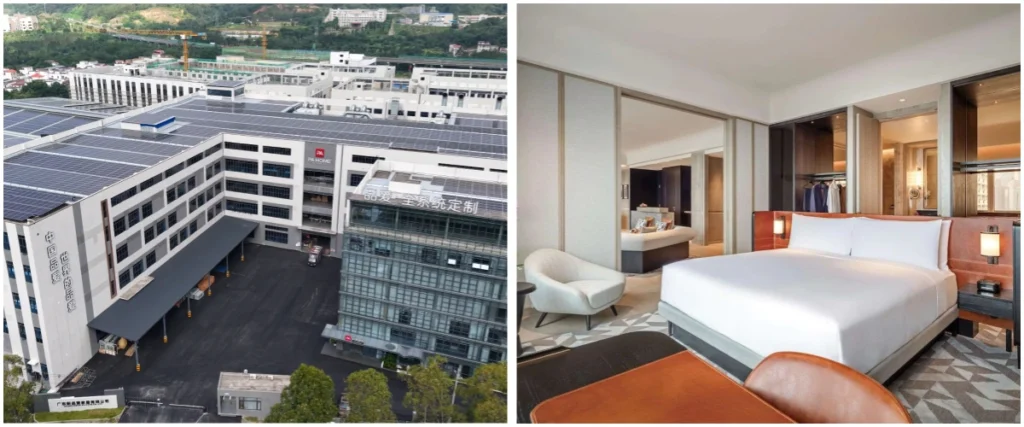
Factory scale and workforce
Assess production space, equipment, and employee numbers to understand real capacity.
Project experience
Review similar hotel projects completed to verify whether the manufacturer has handled comparable volumes and timelines.
Production scheduling transparency
Ask for realistic production and delivery schedules tied to design approval and construction milestones.
Peak capacity management
Confirm how the manufacturer handles overlapping projects or peak production periods.
Logistics and delivery coordination
Ensure packaging, export, and site delivery are managed as part of the project scope, not left to third parties without oversight.

Turnkey Project Capability
In hotel furniture projects, turnkey project capability means a manufacturer can take responsibility beyond furniture production, supporting the project from design coordination to delivery and on-site execution.
Not all suppliers have this capability. Many can produce furniture, but only a few can manage how furniture fits into the overall hotel development process.
A true turnkey-capable manufacturer typically handles:
- Early coordination with designers and project teams
- Shop drawings and technical details aligned with construction
- Integrated management of fixed furniture, loose furniture, and FF&E
- Coordinated production, packaging, logistics, and site delivery
For hotel owners and developers, this capability directly affects opening timelines and revenue generation.
How to Quickly Identify True Turnkey Capability
To determine whether a manufacturer truly offers turnkey support, decision-makers should focus on a few key questions:
Are they involved early in the project stage?
Turnkey manufacturers usually support design development and technical coordination before production begins.
Can they coordinate fixed furniture with construction and fit-out?
Look for understanding of how furniture interfaces with walls, floors, MEP systems, and finishes.
Is there a clear project management structure?
Dedicated project coordination, scheduling, and communication are essential.
Do they manage delivery and site coordination—not just production?
True turnkey support ensures furniture arrives on site in the correct sequence and condition for installation.

SUPPLIER EVALUATION · 2026 HOTEL PROJECTS
Who Is This Type of Manufacturer Right For?
Not every hotel project requires a fully customized, multi-category, turnkey furniture manufacturer. Understanding whether this type of manufacturer is the right fit helps hotel stakeholders make more efficient and realistic decisions.
This Type of Manufacturer Is a Good Fit If You Are:
- Hotel owners or developers managing medium to large-scale projects
Projects involving multiple room types, suites, or public areas benefit from integrated customization and coordinated execution.
- Developers seeking long-term value rather than lowest upfront cost
When durability, quality consistency, and lifecycle performance matter, stronger manufacturing and project capability becomes critical.
- Contractors or project teams working on tight construction schedules
Manufacturers with production planning and delivery coordination experience help reduce schedule risks and on-site conflicts.
- Trading companies handling complex hotel furniture scopes
Multi-category and turnkey capability simplify coordination and reduce dependency on multiple sub-suppliers.
This Type of Manufacturer May Not Be the Best Fit If:
- The project scope is small, standardized, or based on ready-stock furniture
- The primary decision factor is lowest unit price, rather than delivery reliability or quality consistency
- There is no requirement for customization or fixed furniture integration
- Furniture procurement is isolated from the overall construction timeline
HOTEL FURNITURE SUPPLIER
Which Suppliers Actually Meet These Criteria?
Not all hospitality furniture suppliers are equipped to meet the requirements outlined above. Manufacturers that truly align with these standards typically combine multi-category customization capability, stable manufacturing systems, reliable delivery planning, and turnkey project coordination.
In practice, this level of capability is more commonly found in manufacturers with long-term hotel project experience, in-house production control, and regional manufacturing support. These suppliers tend to work closely with hotel owners, developers, contractors, and trading companies—not just as product providers, but as project partners.
CenSo Home is one example of a manufacturer operating within this framework.
By supporting both fixed and loose furniture customization, maintaining controlled production processes, and operating manufacturing facilities in Saudi Arabia and Indonesia, CenSo Home is positioned to support complex hotel projects that require consistency, coordination, and reliable delivery.

Conclusion
Choosing a custom hospitality furniture manufacturer is about reducing project risk and ensuring long-term success, not simply purchasing furniture. As hotel projects grow in scale and complexity, manufacturers are increasingly expected to act as project partners, not just suppliers.
This guide highlights the key criteria that truly matter in hotel furniture selection:
the ability to customize and coordinate both fixed and loose furniture, stable manufacturing and quality control systems, reliable production capacity and delivery planning, and proven turnkey project capability. These factors directly affect project timelines, quality consistency, and operational performance after opening.
Manufacturers that meet these standards typically offer integrated production, multi-category project experience, and delivery coordination beyond the factory floor. CenSo Home operates within this category, supporting hotel projects through coordinated customization, controlled manufacturing, regional production capabilities, and project-based delivery.
Looking ahead to 2026 and beyond, choosing a manufacturer aligned with these principles helps turn furniture procurement into a controlled, strategic advantage—supporting smoother project execution and long-term value.